Cafe Shutters

Cafe Shutters in Lebanon, IN

Privacy at eye level, daylight over the top

Call (317) 863-9966Get Free Quote
Quick Answer

These questions cover how this product actually behaves in a house rather than in a photograph. Light, privacy, operation and durability all look different once something has been hanging through a full year.

  • Service: Cafe Shutters for Lebanon homeowners
  • Service area: Lebanon, IN and surrounding areas
  • If a mechanism has failed rather than a whole product, that's a service call and it moves quickly since we're fitting parts rather than ordering a custom build. New orders follow the usual two to five week fabrication.
  • Insured and bonded
  • Serving Lebanon, IN since 2008
Cafe Shutters Services

Expert Cafe Shutters for Lebanon Homes

A cafe shutter covers the bottom half of an opening and leaves the top open, which is exactly right where the house sits close to the sidewalk. Lebanon's pre-1940 blocks along East Washington Street and North Lebanon Street were platted before anyone thought about a deep front setback, so a front room window looks straight at people walking past. Half height panels give you privacy at seated eye level while daylight keeps coming over the top. On a 1950s Cape Cod with one broad front opening, the same logic applies at a different scale, and the panels line up with a horizontal the house already has.

The trade is that the top half is doing nothing for you. Afternoon sun still comes over the panels, glare on a screen is unaffected, and on a west facing front room the heat arrives as though nothing is fitted. If either of those is the actual complaint, a full height shutter or a shade above the cafe panels is the honest answer. There's also a design constraint: the panels need a horizontal line to stop at. Where the opening has no natural divider, we set one, and on an out of square opening in Lebanon's pre-1980 stock, which is 4,528 units, that line has to be set by measurement rather than by eye.

When to Call

Signs You Need Cafe Shutters

If you notice any of these in your Lebanon home, it is worth booking a measure. None of it is urgent, and none of it fixes itself either.

A bay window has never had anything on it

Plants on the sill freeze against the glass in January

Blinds cover glass you would rather leave open

The sill is too deep for panels to swing

There isn't enough depth for a full shutter frame

A tub sits under a window with no privacy

At night the lit room is visible from the street

Curtains keep landing in the kitchen sink

A powder room window faces a neighbor's driveway

Neighbors can see in at sitting height

Our Process

How Lebanon Window Treatments Handles Cafe Shutters

Every job follows the same five-step process. Transparent, thorough, and done right the first time.

1

In-home measure and room walk

2

Openings measured, out-of-square recorded

3

Panel swings and T-posts drawn

4

Contract signed with total price

5

Mounting method set: frame or strip

Real Project Photos

Cafe Shutters in Lebanon

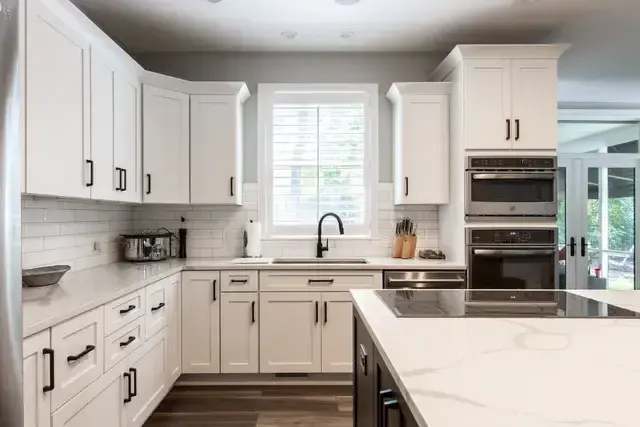
Photographs from real cafe shutters jobs completed by our crew in Lebanon and surrounding areas.
Custom shades measured and installed in LebanonPlantation shutters fitted to a Lebanon windowCellular shades in a Lebanon living room
Scope of Work

What Cafe Shutters Includes

Every Lebanon job is documented item by item. Here is what the crew covers.

The divide height decided at the window with you standing in the room and then sitting in it

Three widths and three heights taken across the lower part of the opening, plus a diagonal check for square

The horizontal bar across the middle of the opening located, since that's usually where the panels should stop

One divide height carried across every window in the room instead of being set opening by opening

The sightline from the sidewalk checked, because privacy at sitting height is the whole point of the product

Mounting depth read at the lower corners so panels clear handles, cranks and anything else inside the opening

Frame style chosen per opening: an L-frame inside, a Z-frame lapping the casing, or a hanging strip on the face

Whether the top of the panel gets a capping frame or is left open decided at the measure, since that edge is visible

Material specified per room, poly or composite where humidity swings and hardwood where the room stays conditioned

Louver size chosen against a short panel, where a large louver reads out of scale faster than it does full height

Panel count and swing direction drawn so nothing hits a faucet, a countertop or a window crank

A T-post drawn on wide openings so each panel stays a width that swings properly and stays flat

Divider rails left out unless the panel is unusually tall, since a cafe panel rarely needs one

Hinge style and finish chosen knowing the hardware sits at eye level for anyone sitting down

Paint or stain matched to the existing trim with a physical sample in the room, never off a screen

Whatever goes above the panels planned in the same visit, or the upper glass deliberately left bare

Written contract with scope, dates and total price, as IC 24-5-11 requires on residential work over $150

Frames shimmed plumb, louver tension set panel by panel, then caulk and touch-up run at the frame line

Pricing

What Cafe Shutters Cost in Lebanon

Published national figures for interior shutters run roughly $175 to $800 per window. That's a national range for the category and it isn't a price for any opening in Lebanon. Cafe shutters land lower in that band than full-height panels, though not by as much as people assume. You're covering half the window, so there's less material. You are not doing half the work. The frame still gets built to the opening, the hinges still get hung, the finish still gets matched to your trim, and somebody still has to stand at the window and decide where the divide goes. Across Boone County, the openings that cost most are wide ones needing a T-post and old ones that have settled well out of square.

By Product

How Cafe Shutters Differ by Product

Every product in this trade behaves differently in a room. Here is what that means for this work.

Poly and composite panels: An engineered core with a hard painted finish that ignores moisture. This is what goes over a kitchen sink and in a bathroom, because Indiana humidity moves hardwood and a moved panel stops closing against its neighbor.

Hardwood panels: Usually basswood, lighter for the same panel and able to carry a stain that shows grain. On a short cafe panel in a conditioned front room, stained hardwood against original trim is a look no painted composite gets close to.

2 1/2 inch louver: The right default on a half-height panel. A short panel only holds so many louvers, and going small keeps the proportion sane and gives you finer control over the angle you tilt them to.

3 1/2 inch louver: Worth using where the lower part of the window is unusually tall, or where full-height shutters elsewhere in the house already use this size and you want the rooms to agree with each other.

L-frame: A simple right angle sitting inside the opening, lapping the face of the trim slightly. It's the cleanest install when the opening has depth, and on a cafe it keeps the frame from drawing attention to the fact that it stops halfway up.

Z-frame: Adds a flange that covers the edge of the existing casing, which hides an opening that has settled and gives the installer somewhere to take up the difference. It's the usual answer in an older house, where nothing is quite plumb.

Hanging strip on the face: Hinges mount to a narrow strip fastened onto the face of the casing rather than a full frame. It's the lightest-looking option, it works where the opening has almost no depth, and it puts the panels proud of the trim.

Hidden tilt rod: The linkage moves into the stile so the louver face is uninterrupted. On a cafe panel that sits right at eye level for anyone at a table, losing the center rod makes a noticeable difference to how the window reads.

T-post on a wide opening: A fixed vertical post between panels so no single panel gets wide enough to sag or swing badly. It also gives the louvers something to close against in the middle, which is where a wide cafe otherwise leaks light and sightlines.

A shade above the panels: A roller, a Roman or a woven natural mounted above the cafe shutters covers the upper glass when you want it covered. This is how you keep the daylight most days and still kill a low sun that comes straight down the street.

Common Questions

Cafe Shutters FAQ

Questions we hear most often from Lebanon homeowners considering cafe shutters.

On a line the opening already has, if there's one, and otherwise at a height we set by measurement rather than by eye. Traditionally the panel tops align with a horizontal in the window itself. Where nothing exists to follow, we look at seated eye level in that room and at the sight line from the sidewalk, then check that the line reads level against the head trim, which in a pre-1940 Lebanon house is frequently not level at all. Getting this wrong is the most visible mistake possible on a front elevation.
Seated, yes. Standing, no, and that's worth understanding before you order. On the older blocks running off the courthouse square, where houses sit close to the walk, a half height panel stops a passer by seeing anyone on the sofa while leaving the upper part of the room visible from the street. At night with lamps on, the open top becomes a lit rectangle. Households that want evening privacy pair the shutters with a top down shade above them, which keeps the daytime look and closes the gap after dark.
On the residential upper floors, comfortably. On the storefronts themselves, less so, because the ground floor frames on those blocks have almost no depth and the whole point of the storefront glass is that people look through it. The square carries a Downtown DORA District, so street level frontage is actively programmed for trade and merchants generally want the display visible. Where a business wants privacy at the lower half of a window, a half height shutter on an L-frame mounted to the face of the trim works, since there's no depth to set it into.
Per opening, yes, because there's roughly half the material and half the hardware. National figures put shutters at about $175 to $800 per window, and a cafe panel sits toward the lower part of that band on the same opening. What people miss is that a cafe shutter often gets paired with something above it, and once you add a shade over the top the combined cost passes a full height shutter. If the top half is going to need covering anyway, we'd rather price the full height from the start.
Smaller than you'd use full height. A 4 1/2 inch louver on a panel that's only 30 inches tall gives you five or six louvers and reads as a fence rather than a shutter. A 2 1/2 inch louver keeps the proportion right at that height and gives finer control over the angle, which matters because on a cafe panel you're constantly adjusting for people walking past. On a taller half panel, on a 1950s picture window for instance, 3 1/2 inch usually balances between the two.
It will let in exactly as much as an uncovered window would, because that is exactly what it is. On a Lebanon July afternoon with an average high of 85.2 degrees, a west front room with cafe shutters gets the full solar load through the upper half of the glass. That isn't an argument against the product, it's an argument for knowing what it does. Adding a solar shade above the panels, mounted to the head trim so it drops behind nothing, handles the heat while leaving the shutter look intact from the street.
They're shutter panels covering only the lower part of the window, with the upper glass left open. You get privacy at sitting height and you keep the daylight and the ceiling height above. They turn up constantly in older housing stock with tall windows, and in any front room where the sidewalk is close enough that people can see in. In a Lebanon house with good original trim, half shutters let the window keep its proportion instead of getting boxed in from top to bottom.
At the window, with you there. If the opening has a horizontal bar across the middle, that's usually the line, because stopping anywhere else looks accidental. If there isn't one, we set the height by eye: someone sits where you actually sit, someone else stands outside where a person would walk past, and we find the height that covers what you want covered. Then we carry that same height across every window in the room, which matters more than the exact number does.
At street level, yes, and that's the honest boundary of the claim. Closed louvers on the lower half block the sightline from a sidewalk or a driveway completely. What they don't do is stop someone on a second story next door, or a delivery driver standing on a raised porch, from looking over the top. In a dense older block we check that at the measure by walking outside and looking. If the geometry doesn't work, we say so and talk about full height instead.
It comes straight in, which is usually why you wanted cafe shutters in the first place. The problem case is a low winter sun or an afternoon sun coming down a street at eye level, where the open upper glass puts it right in your face. Two fixes: a shade above the panels that you drop for those hours, or a treatment across the top of the window. We ask which direction the room faces before assuming bare glass up top is what you want.
Yes, and it's worth thinking about now even if you don't buy it now. A roller or a Roman mounted above the panels needs somewhere to land, and if the shutter frame runs to the top of the opening you've made that harder. When we know a shade is coming, we set the frame and the mounting surface so brackets have room. Doing it in that order is cheap. Doing it afterward sometimes means moving hardware you've already paid to install.
Cheaper, yes. Half price, no. You're buying half the material, but the frame is still built to your specific opening, the hinges still get hung, the finish still gets matched to your trim, and the measure takes just as long. So the saving is real without being proportional. Where cafe genuinely wins on cost is a very tall window, because full-height panels on a big opening need divider rails and get heavy, and half the height skips all of that.
Poly or composite, without much debate. A cafe shutter over a kitchen sink lives in steam and gets splashed, and it collects whatever the faucet throws at it. Hardwood in that spot takes on moisture, the stile gains a hair of width, and a panel that closed cleanly in March starts rubbing by August. Poly doesn't do that and takes a damp cloth without complaint. Save the hardwood for a dining room or a front room that stays conditioned all year.
It's a real decision and it changes the look. A cafe shutter is open at the top by definition, so the top edge of the panel is visible in a way it never is on a full-height install. You can cap it with a light frame member, which reads more finished and gives the panel a defined top line. Or you can leave it open, which is cleaner and lets the panel read as a piece of furniture. We show you both at the window and let you pick.
Smaller than you'd use full height. A cafe panel only has so much room, and a wide louver on a short panel means three or four of them and a face that looks chunky and out of scale. Two and a half inches is the usual answer and it also gives finer control over the tilt angle, which matters when you're adjusting for a sun that's low in the sky. Three and a half works where the lower part of the window is unusually tall.
This is the question that decides whether a room looks designed or looks patched. If the openings themselves start at different heights off the floor, matching the panel tops matters more than matching the panel heights, because the eye reads the top line across the room. We measure everything first, pick the line, then build panels of different heights to land on it. In an older Lebanon house where nothing matches, that decision does more visual work than the shutters themselves.
They can, though they need the right window. The product wants height above the divide to make sense of itself, so it belongs on a tall opening rather than a wide, short one. On a standard-height window in a newer build, half shutters often just look like the installer ran out of parts. Where they do work in newer houses is a tall stairwell window, a dining room with big openings, or a front room where the neighbor is close and the view up top is worth keeping.
Because you want the privacy without giving up the window. Full-height panels are a wall of louvers, and even open they put a frame and stiles across the whole opening. Cafe shutters solve the sightline problem at sitting height and leave the top of the window doing what it was there for. There's also the money on a tall window, and there's the fact that a plant shelf or a deep sill stays visible. If you need light control at all hours, full height is the honest recommendation.
Yes, and the angles are the interesting part. Each section gets its own frame and its own panels, and the corners where two sections meet need working out so panels swing without hitting each other. The divide height runs continuously around the bay, which is what makes it look intentional. We template the angles on site rather than assuming 45 degrees, because bays built decades apart in this area are rarely the angle anyone expects.
Not usually, but it changes the drawing. We check how far the faucet projects, how it swings, and whether a panel opening toward it will clear. Sometimes the answer is mounting the frame on the face of the casing so the panels sit proud of the opening. Sometimes it's changing which way a panel swings, or adding a T-post so the panels are narrower and open in a shorter arc. What we won't do is order and find out on install day.
Areas We Serve

Cafe Shutters Across Lebanon

We measure and install in every one of these Lebanon neighborhoods. Each has its own page with the build eras, window conditions and mounting notes for that section.

Related Services

Other Window Treatment Services in Lebanon

Lebanon Window Treatments handles the full scope of window treatment work. Explore our other services below.

Free In-Home Measure

Schedule Your Free In-Home Measure in Lebanon

Contact Information

Reach Us Directly

Our team prioritizes scheduled measures and service calls, and books in-home measures during business hours.

Office
1417 Commerce Avenue, Indianapolis, IN 46201
Hours
Mon-Fri 8a-6p
Service Area
Lebanon, IN and Surrounding Areas

Ready to Book Your Measure?

Call us to set up an in-home measure, or to ask about a treatment that has stopped working. We will talk it through on the phone first.

Service area

Serving Lebanon and the surrounding area

Call NowGet Quote