Window Treatments for Tall and Oversized Windows in Lebanon
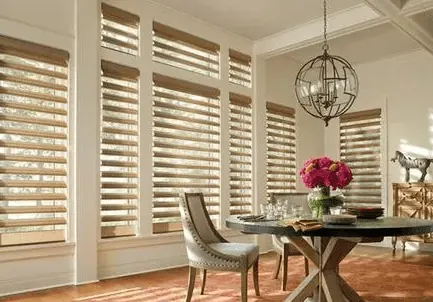
Covering a full wall of glass in a great room is a different budget conversation than a standard bedroom window, and it's worth understanding where the extra cost actually goes before getting a quote.
Why Size Pushes Hardware Past Its Limit
Standard shade hardware is engineered around standard window sizes, and once you're past roughly eight feet of drop or a width pushing toward ten or twelve feet, the parts built for an average window start working harder than they were designed to. A roller tube that's fine at six feet can start to sag or deflect in the middle at twelve feet wide, showing up as a visible bow across the top of the shade.
Weight is the other half of the problem. A tall drop means more fabric, and more fabric means more weight hanging off the same clutch or spring mechanism that a smaller window uses. Standard residential hardware has a real weight ceiling, and a lot of Lebanon homes with two-story windows or a wide wall of glass in a great room bump right up against it without anyone realizing until the shade starts struggling to hold its position.
Reaching the Control on a Window That Tall
A common measuring mistake is treating the control length as an afterthought instead of planning it alongside the drop measurement. A wand or cord ordered to a standard length on a nonstandard window ends up too short to reach or, just as often, way too long and pooling on the floor.
Getting this right means measuring the actual mounted height and factoring in exactly how the finished product will hang before ordering a control length, not assuming a standard size will work because it usually does on smaller Lebanon windows.
One Shade or More Than One
Splitting a wide window into multiple shades affects cost less than people expect, since the total fabric and hardware needed is roughly similar either way, just distributed across more units. Where cost does shift is in the number of mechanisms and control points, since three smaller shades need three clutches or three motors instead of one large one.
As a national range, expect roughly $200 to $600 a window installed for custom shades sized for an oversized opening, with the upper end of that range more likely on a wide window needing reinforced hardware or a motor. A Lebanon quote for a full window wall should break down per-shade pricing so you can see exactly where the total comes from.
It's also worth asking whether a quote is pricing each section as a full custom shade or applying some kind of multi-unit pricing for a single window opening that's been split into pieces. Practices vary by installer, and the difference can matter on a window wall with several sections.
Measuring and Installing on a Window That Big
A split configuration changes what the measure needs to capture, since each section needs its own precise width and the gaps between sections need to be planned before ordering, not adjusted after the fact. Getting the spacing between shades even and intentional looking takes more planning upfront than a single shade would.
This is another spot where an in-person measure matters more than it would on a standard window, since a Lebanon installer walking the actual space can plan mullion alignment and section widths in a way that's difficult to get right from measurements alone without seeing the window in person.
This planning conversation is worth having early, ideally before any construction or drywall work near the window wraps up, since running power for a motorized option or confirming mullion spacing is far easier before the finishes go in than after.
Getting an accurate cost picture for a window wall starts with an actual measurement, not a national average. A free in-home measure from Lebanon Window Treatments breaks the pricing down section by section so you know where the budget is actually going. Call (317) 999-5154 to schedule one.
Where All That Fabric Goes When It Stacks
Motorization doesn't change where the fabric stacks when a shade is raised, that's still a function of the fabric and drop length, but it does make cassette-style headrails easier to justify, since a motor is already housed in the tube and a cassette keeps both the mechanism and the stacked fabric fully enclosed for a cleaner look.
A tall motorized shade with a well-planned cassette can raise almost out of sight, showing only a slim housing at the top of the window rather than a visible bundle of fabric, which matters on a Lebanon great room window where the shade is meant to disappear when it's not needed.
Retrofitting an older, non-motorized tall shade with a battery motor is possible in some cases, though it depends on whether the existing tube and mounting hardware can accept the retrofit motor's added weight and dimensions, which circles back to the same hardware question that comes up throughout an oversized installation.
Frequently Asked Questions
Why does measuring a tall window take longer than a standard one?
A standard window usually needs one width and one height measurement. A tall or oversized window needs measurements at more than one point along the frame, since it's more likely to be slightly out of square, plus a check on access for both the measure and the eventual install, plus a look at stack height and hardware requirements for that specific size. Each of those adds time but also prevents an expensive mistake later.
What happens if a shade is ordered without accounting for the window being out of square?
The shade gets built to the dimensions it was given, so if those dimensions didn't account for the window being slightly wider at the bottom than the top, or vice versa, the finished shade can bind against the frame on one side or leave a visible gap on the other. It's a common enough issue on older or custom-built openings that a careful measure checks for it specifically rather than assuming a single measurement is enough.
Do two-story or stairwell windows really need special equipment to measure and install?
Often, yes. A window that's not reachable from the floor or a standard ladder often needs a taller ladder or scaffolding to measure accurately and install safely, and that access requirement doesn't go away between the two visits. It's worth asking upfront whether a quote includes that access cost, since it can be a meaningful part of the total on a genuinely hard-to-reach window.
 Covering a Sliding Door Without Getting in the Way of the Door
 Where Roller Shades Belong in a Lebanon House, Room by Room
 What Actually Goes Wrong With Motorized Shades in Lebanon